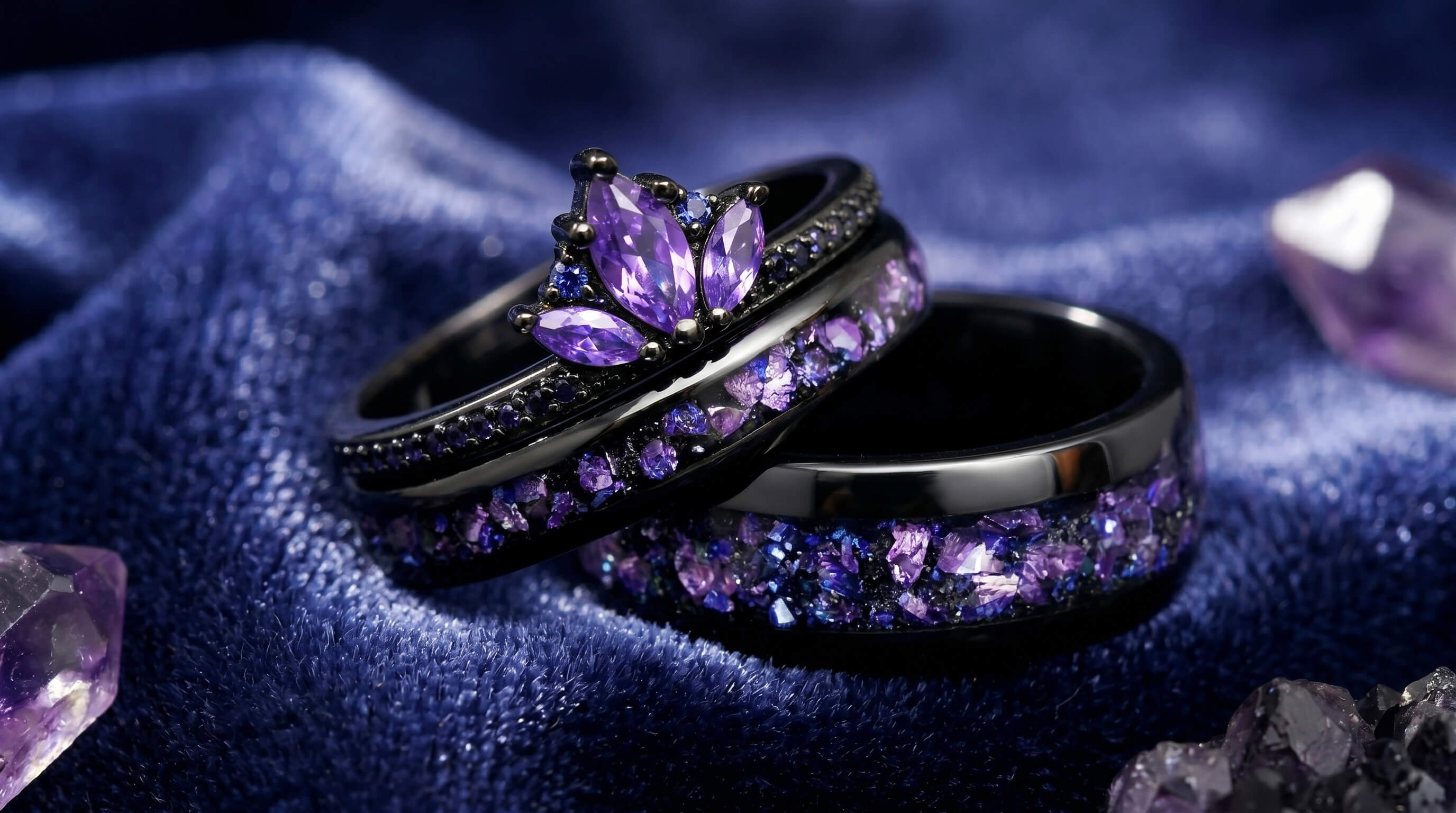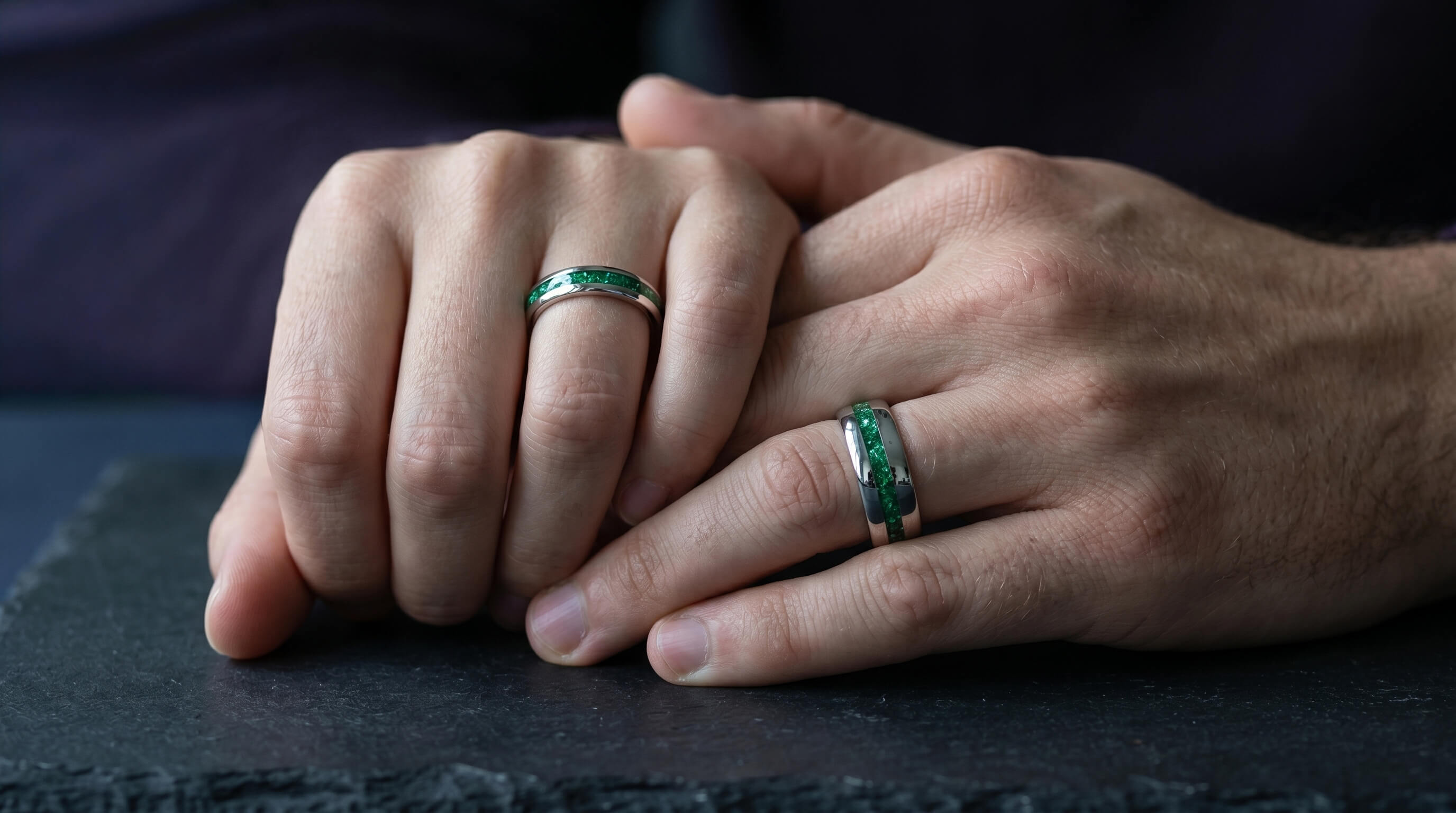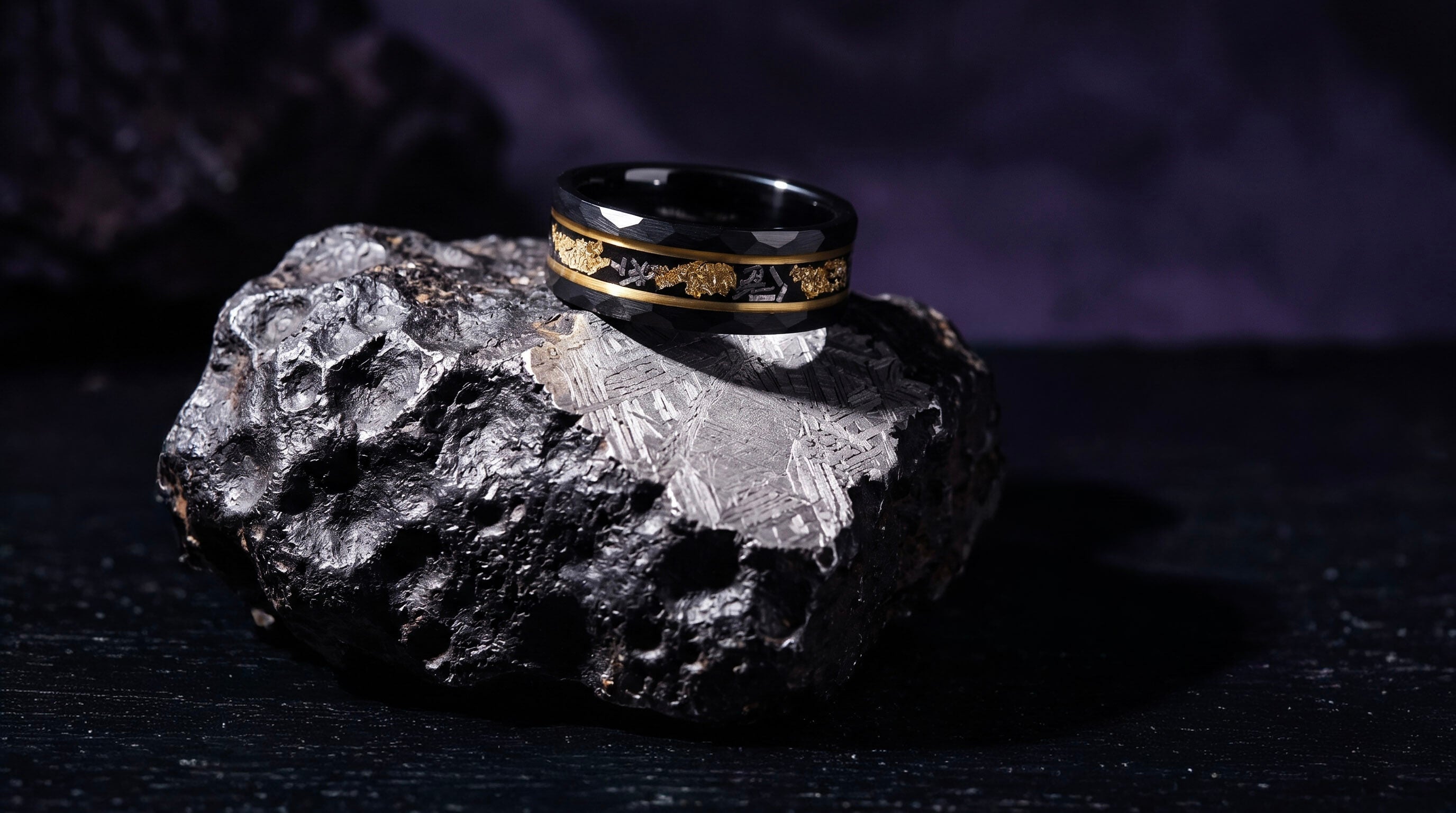
A men's meteorite wedding band is a tungsten ring with real meteorite metal sealed inside the band as an inlay. The meteorite itself is iron-nickel that fell from space, and the tungsten base handles the durability. Real meteorite has a one-of-a-kind look that no two rings can match. Expect to pay $100 to $400 for a quality ring. And because the meteorite is sealed inside the band, our rings don't rust like the exposed-meteorite rings you'll see elsewhere.
If a wedding band is supposed to last a lifetime, the material has to back that up. Meteorite is one of the few materials that earns the comparison. It's older than Earth, it has a metallic crystalline structure that nothing on this planet can replicate, and it pairs with metals that hold up to daily wear. This guide is everything men actually need to know before buying one.
What Is a Meteorite Wedding Band?
A meteorite wedding band is a ring that uses real fragments of an iron meteorite, set into a stronger base metal that gives the ring its structure. The base is almost always tungsten or titanium. The meteorite goes into a channel cut into the band, where it's sealed under a clear protective layer.
The reason meteorite isn't used as a solid ring on its own is simple. Pure meteorite is brittle and porous. It would crack under daily wear and rust quickly without protection. Pairing it with tungsten solves both problems. You get the look of space metal with the toughness of one of the hardest materials used in jewelry.

You'll see two construction styles in the market. The first uses thin slices of meteorite. The second uses meteorite shavings or flakes set into the band. Both are real meteorite. The difference is what happens at daily-wear scale. Slice-construction rings often leave the meteorite exposed at the surface, which means the iron can rust if it gets wet. Shaving-construction rings, like the ones we make at Foreverings, fully encapsulate the meteorite under a sealed protective layer. The meteorite is real, but it never touches water, air, or skin. It can't rust because it can't get wet.
What Makes Gibeon Meteorite Different
Most meteorite rings sold today use Gibeon meteorite, named after the town in Namibia where the fragments were found. Gibeon is an iron meteorite from the core of a shattered asteroid, with a high nickel content that gives it two important traits. First, it has a recognizable crystalline metallic structure. Second, the nickel content makes it more rust-resistant than other meteorite types, even before any sealing is applied.
The crystal structure inside Gibeon meteorite is called a Widmanstätten pattern. It forms only when molten iron and nickel cool at a rate of about one degree per million years, which can only happen in the vacuum of space. That's why it's impossible to fake convincingly. Anything you see on a $20 ring online that calls itself meteorite is almost certainly foil or printed.
Gibeon is also a finite resource. Namibia has banned further collection and export, so existing stock is what the market has, and specimen-grade pieces now trade in the thousands of dollars per slice. That scarcity is part of why real Gibeon in a ring is meaningful.
Our meteorite is real Gibeon, in shaving form, sealed into the tungsten band. You get the same authentic iron-nickel metal that solid-slice rings use. What you see in the inlay is the real metallic structure of iron meteorite, not simulated, not pressed dust, not foil.
How to Tell If a Meteorite Ring Is Real
There are a few ways to spot a real meteorite ring before you buy. Use these as a checklist for any seller, including us:
- The meteorite shows real metallic crystalline material, not a printed surface. Real iron meteorite has a silvery-gray metallic look with visible texture. Fakes look flat or repeat in a predictable way.
- The seller can tell you which meteorite type it is. Gibeon, Muonionalusta, Campo del Cielo, and Seymchan are the main ones used in jewelry. If the seller can't name the source, that's a flag.
- The price isn't too low. A real meteorite ring with a tungsten base will almost never cost under $80. If you see meteorite rings on eBay or Amazon for $15 to $40, the meteorite isn't real.
- The seller offers some form of authenticity statement. Reputable jewelers state directly that the meteorite is real, not simulated.
- The meteorite is sealed. Real meteorite contains iron, which means unsealed meteorite can rust over time. A reputable jeweler will seal the inlay so the meteorite is protected for life. Our rings use a fully sealed inlay design.
If a ring passes all five, it's almost certainly real. If a ring fails two or more, walk away.
Are Meteorite Wedding Bands Durable?
Yes, and the construction matters more than most buyers realize.
Tungsten is the dominant base material for men's meteorite rings, and there's a reason. It's one of the hardest metals used in jewelry, scratch-resistant in everyday wear, and tough enough to handle the impacts that come with manual work or active hobbies. The meteorite inlay sits inside a channel where the tungsten frame fully surrounds it. The meteorite is never exposed at the surface, which means impacts hit tungsten, not meteorite.
Titanium is the second most common base. It's lighter than tungsten, hypoallergenic for guys with nickel sensitivity, and almost as durable. Both are solid choices.
Here's where construction makes a real difference. Many meteorite rings on the market use a slice of meteorite that sits flush with the surface of the band. That looks great on day one, but the iron in the meteorite is exposed to water, sweat, soap, and air. Over time, those rings can rust. Sellers in this category will tell you to take the ring off before showers, pools, hot tubs, and the ocean. They're not wrong. The meteorite in those rings really is at risk.
Our rings are built differently. The meteorite shavings are sealed inside the band under a protective layer. Water, chlorine, salt, sweat, and air don't reach the meteorite. There's nothing to rust. You can wear our rings in the shower, in the ocean, in the pool, at the gym, on the job site. The meteorite stays protected because the construction keeps it protected.
Construction format is the single biggest factor in whether a meteorite ring is genuinely daily-wearable or whether it's a piece that demands a separate silicone backup ring for half the activities you actually do.

How to Care for a Meteorite Ring
If you bought one of our meteorite rings, the care list is short. Wipe it occasionally with a soft, dry cloth to remove skin oils. That's it. The meteorite is sealed inside the band, which means none of the usual meteorite warnings apply to your ring. You don't need to remove it for water exposure. You don't need to oil the meteorite. You don't need to worry about rust.
If you bought a meteorite ring with exposed meteorite (a slice-construction ring from a different brand), the care list is longer. Those rings need to stay dry, get oiled occasionally to prevent surface rust, and come off for showers, swimming, and any prolonged moisture exposure. The chemistry is straightforward: exposed iron plus moisture equals rust over time.
The construction makes the difference. Our ring care guide covers tungsten care basics in more depth for anyone who wants the long version, but for most owners, the soft cloth wipe is the whole maintenance routine.
Styles, Widths, and Finishes for Men's Bands
Most men's meteorite wedding bands run in either 6mm or 8mm widths. The 8mm reads as substantial and looks proportionally right on larger hands. The 6mm leans more refined without losing the masculine profile. If you're unsure, default to 8mm. Meteorite is a material that benefits from real estate to show off the iron-nickel material.
Color options affect the look more than people expect.
Black tungsten with meteorite is the most popular look. The black base makes the silvery-gray meteorite material pop, and it pairs naturally with cosmic or space-inspired aesthetics. The look reads as bold and modern.
Silver or unplated tungsten leaves the band in its natural gray, which sits between the meteorite tone and a traditional silver wedding band. This is the most classic choice and the easiest to pair with other jewelry.
Gold-plated tungsten with meteorite combines the warmth of gold with the cool tone of the meteorite. The yellow or rose gold liner shows on the inside or as an accent stripe, with the meteorite as the centerpiece.
Rose gold meteorite rings have grown in demand. The pink-warm tone of the rose gold contrasts beautifully with the silvery-gray meteorite material. This style works well for men who want something less typical than yellow gold but still warm.
Finish-wise, you'll see polished domes (smooth and reflective), hammered surfaces (textured and rugged), and brushed or matte finishes (modern and understated). A hammered meteorite ring is the most distinctive finish. The texture catches light differently across each facet, making the meteorite material feel more dynamic.

Popular Pairings and Combinations
Meteorite doesn't have to stand alone. Some of the most striking men's bands combine meteorite with a second material. These are the pairings that work.
This combination uses real fossilized dinosaur bone alongside the meteorite. Two ancient materials, one cosmic and one prehistoric, set into the same band. A dinosaur bone meteorite ring is a popular choice for guys who want a ring that's also a conversation starter.
Opal pairs visually with meteorite because the iridescent color play of the opal contrasts the metallic look of the meteorite. Galaxy opal, in particular, mimics a starfield, which makes the meteorite-and-opal pairing feel like a complete cosmic theme. Many of our men's meteorite rings combine the two.
Glow stones embedded alongside the meteorite glow blue, green, or red after light exposure. A meteorite ring with glow stones is a true nighttime statement. Meteorite by day, neon glow by night. Pure novelty for some, perfect for others.
A gold leaf or gold liner adds warmth and a traditional touch without compromising the cosmic look. The meteorite stays the visual centerpiece. The gold reads as a premium signal.
Some couples sets pair a meteorite band with a meteorite-and-diamond band for the partner, where the diamond adds a single bright accent against the cosmic backdrop. It's a less common combination but a deliberate one. It signals that the ring is more than a standard wedding band.

Sets, Matching Bands, and Couples Options
If you're shopping with your partner, our meteorite couples sets and matching bands are both common options. Most sellers, including us, offer two band sizes designed to coordinate. The typical pairing is an 8mm men's band with a 4mm or 6mm partner's band, in matching color and finish.
Matching doesn't mean identical. Couples rings work best when the bands share the same construction and meteorite type, but the proportions stay sized to each person. A meteorite ring set should look like a pair, not a duplication.

For couples who want full coordination, the cosmic theme extends naturally. A meteorite band paired with a meteorite-and-galaxy-opal band reads as cohesive without being matchy-matchy. We carry dozens of meteorite sets in this format, including options where one ring has additional inlays the other doesn't.
Some couples sets include a center stone on the partner's ring, where the meteorite band pairs with a stone-set band. These work for couples who want the engagement and wedding band to feel like a continuous design story rather than two separate purchases.
What Does a Meteorite Ring Symbolize?
A meteorite ring carries meaning that most wedding bands can't. The metal itself formed billions of years before Earth existed. It traveled across space, survived atmospheric entry, and landed before any human civilization existed. A ring made from that material isn't symbolic of permanence. It's literally a piece of something permanent.
For men, the appeal often lands on a few specific ideas. The ring stands for resilience: meteorite survived a journey nothing else can match. It stands for individuality: no two pieces of meteorite are alike, so no two rings are identical. And it stands for connection to something larger than a moment, which is the kind of thing a wedding band is supposed to do anyway.
The meaning works without needing to be loud about it. A meteorite ring doesn't announce itself unless someone asks. When they do, the story behind it is one of the best you can hand back.
How Much Should You Expect to Pay?
Pricing in this category varies more than it should, partly because construction quality varies so much. Here's an honest breakdown.
Fake or imitation meteorite rings sell for $15 to $50. These use printed foil or surface-only patterns to imitate the look without actually using meteorite. Avoid.
Real meteorite rings with sealed shaving-construction inlay, in tungsten or titanium, run $99 to $300. This is where our sealed meteorite rings sit, and it's where the strongest value lives in the category. Real meteorite, durable tungsten base, sealed inlay that doesn't rust, and a ring you can actually wear every day without thinking about it. Our range starts at $64.99 for a 6mm men's band and tops out around $269 for couples sets with additional inlays.
Meteorite rings with exposed slice-construction inlay, in tungsten or titanium, cost $300 to $800. The visible meteorite area is larger, but the meteorite is exposed at the surface, which means it can rust without careful maintenance. Buyers in this tier are paying more for a visible slice and accepting the maintenance trade-off that comes with it.
Meteorite rings with inlays set into solid gold or platinum bands run $800 to $2,000. The base metal is genuinely premium, but the meteorite handling is the same as the tier above: usually exposed, usually requires moisture management, and almost never resizable because of the inlay construction.
Solid meteorite rings, made entirely from meteorite without a base metal, start at around $1,500 and climb past $3,000. These are rare and brittle. They need careful handling, can crack under impact, and are not recommended for daily wear unless you're prepared for the maintenance.
For most men, the $100 to $300 range with sealed construction is the right call. You get real meteorite, you get durability, you don't get the rust headache that comes with exposed-meteorite rings at any price point, and the ring costs less than the average traditional solid gold men's wedding band.
Engraving and Customization
Most meteorite wedding bands can be engraved on the inside of the band. The inside of the tungsten doesn't carry the meteorite, so engraving is straightforward.
We offer free engraving on every ring we make. Names, dates, initials, coordinates, song lyrics, short phrases. The inside of the band is yours. A custom meteorite ring with a meaningful engraving is one of the easiest ways to add personal weight to a piece that already carries cosmic weight.
Should You Buy a Meteorite Wedding Band?
A meteorite wedding band is the right choice if you want something that:
- Looks different from every other wedding band you've ever seen
- Has a story you don't have to invent
- Holds up to daily wear without special handling (with sealed construction)
- Costs less than a traditional solid gold men's wedding band
It's not the right choice if you:
- Prefer traditional metals and a classic look
- Want a ring with no inlay at all, just a single solid material
If the first list sounds like you, browse our full collection of meteorite rings. Every ring is real Gibeon meteorite, tungsten base, sealed inlay that doesn't rust, free engraving on every order, and a lifetime warranty with size exchange backing the construction. The meteorite is real, the price is honest, and the ring is one of one.